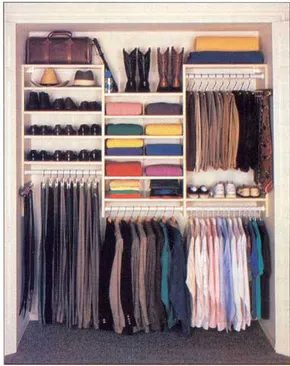
Most men own a wardrobe built around a limited palette. Suits. Shirts. Ties. Jackets. Sweaters. Casual wear. You won’t find the sprawling variety of lengths or styles common in a woman’s closet. Feminine equivalents exist, sure. But the real difference isn’t classification. It’s space.
Men’s garments are generally longer. Except for dresses. That single fact changes everything about how you organize a man’s closet.
Space can be used far more efficiently than you might expect.
Because nothing hangs longer than a suit coat or a standard shirt, you can double-rodd the entire closet. There is no need for vertical clearance that extends above the top of dress shoes or cushioned running shoes. The geometry of the clothes dictates the geometry of the room.
This article explores how to design a man’s closet for maximum storage and efficiency. But first, you need rules. Standard operational procedures. Handling instructions. Without them, you lose control.
The Rules of Hanging
Do not deviate from these guidelines. Once you start improvising, the system collapses.
Slacks
Remove belts. Always. If you leave them on, the weight stretches the fabric out of shape. Belts belong on a dedicated rack.
When you hang slacks, match the inside seam to the outside seam at the bottom edge. Hold the pants at the hem. The crease line appears naturally. Do not button or zip the slacks. That misaligns the crease. Follow the crease up to the waistband. Gently mold the zipper and placket into a fold. Fold the pants near the middle of their length. Insert them onto a hanger. Keep the fold centered on the hanger bar.
Some guys prefer to hang slacks by their full length using a clamp hanger. Warning: these hangers can mar the cuffs. Pressure marks are difficult, sometimes impossible, to remove. If you want your trousers to look crisp, skip the clamps.
Shirts
Fasten the top button. Maybe the top two. But best of all? Button every other button for the entire length of the garment. This minimizes wrinkles. It prevents cock-eyed collars.
Hang the shirt. Place the hanger on the rod. Ensure all hangers face the same direction. Consistency matters.
Here is the worst habit you can develop: pulling a garment off its hanger by the fabric. Don’t do it. Remove the hanger from the rod first. Then unbutton the garment from the hanger. Place the empty hanger in your workspace area.
Seasonal Storage Logic
The question of seasonal clothes usually arises mid-process. It feels like a waste to keep winter coats hanging in July. And vice versa.
But storing out-of-season clothes separately is a nightmare. It involves dry cleaning. Mending. Folding. Packing. Finding. Unpacking. Later.
The choice depends on your preference. It depends on closet space. It depends on whether you have extra closets elsewhere in the home. If you have the room, leave them in. If you don’t, you’ll need a dedicated off-season strategy.
Floor Space and Design
Keep all supports and appointments off the floor. This is non-negotiable for cleaning. You need to run a vacuum cleaner or dust mop into every corner. Reach every inch where dust collects.
Each part of your closet can be designed in various configurations. You must determine which aspects are productive for your circumstances.
Look at alternative arrangements. Coming up with an alternative design requires thought. Speculation. The time spent designing an alternative is often worthwhile. The result might be a truly innovative finished product.
Evaluate and compare several closet renovation projects.
Find special features in other setups. Eventually, you’ll arrive at an arrangement that satisfies your personal needs.
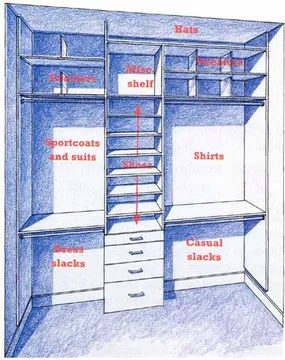
Sometimes you run out of math. No amount of measuring, diagramming, or shelf-stacking tricks will squeeze more volume into a physical space. The walls won’t move. The ceiling stays put. If your closet is simply too small for your wardrobe, you’ve hit a hard limit.
But that doesn’t mean you’re stuck with chaos.
Adhering to strict organizing principles still yields results. You might not get more space. But you can maximize the space you already have. The goal shifts from expansion to optimization.
How do you do that?
By treating every inch of the closet as a functional zone.
- Verticality is non-negotiable. Use the full height of the closet. Install additional hanging rods or use tension rods for shorter items.
- Uniform hangers matter. Switching to slim, non-slip hangers can free up 20% more linear hanging space.
- Declutter ruthlessly. If you haven’t worn it in a year, it doesn’t belong in the closet. Period.
- Use drawer dividers. Small items like socks and underwear should never be tossed in a pile. They need structure.
- Label bins. If you store off-season clothes, know exactly where each bin is without opening it.
“The most storage space possible is not about adding more shelves. It’s about removing waste.”
This isn’t magic. It’s discipline.
You’re not fighting the size of the room. You’re fighting the inefficiency of your habits.
It works. Until you buy too many shoes.