Lighting used to suck. Before the bulb, staying up past sunset meant fiddling with candles or oil lamps. It was messy. Hazardous. You’d end up with soot on the walls and a constant fear of setting the house on fire.
Then came the mid-1800s. Sir Joseph Swan and Thomas Edison were racing to build a practical, affordable electrical light. Swan got there in 1878. Edison followed in 1879. Within 25 years, millions of homes wired themselves for electricity. It was an instant win. The old ways died fast.
The weird part? The device itself is stupidly simple. Modern bulbs barely changed from Edison’s original design. Just a handful of parts. That’s it.
Here is how those parts make light. And why you should care if you are fixing your own wiring.
How light actually gets made
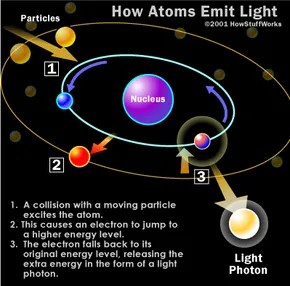
Light is energy. Specifically, it comes from atoms.
Think of an atom like a tiny solar system. You have a nucleus in the center. Positively charged. Orbiting it are electrons. Negatively charged.
Here is the trick. Electrons have energy levels. They live in specific orbitals. Higher energy means they hang out farther from the nucleus. Lower energy means they stay close.
When an atom gets energy—say, from heat or electricity—an electron gets excited. It jumps to a higher orbital. Farther out.
It doesn’t stay there.
It falls back. Almost instantly. As it drops to its original spot, it has to get rid of that extra energy. It shoots it out as a packet called a photon.
That photon is light.
The color depends on the jump. A big drop releases more energy. That makes blue or violet light. A small drop releases less. You get red. Different atoms mean different colors.
This is the same physics behind neon signs, LEDs, and your incandescent bulb. The only difference is how we get the atoms excited.
What’s inside the bulb
You don’t need a physics degree to change a bulb. But knowing what’s inside helps you understand why they burn out.
The classic incandescent bulb has four main jobs to do:
- Generate light: Heat the filament until it glows.
- Protect the filament: Keep oxygen out so it doesn’t burn up.
- Conduct electricity: Get the power from your wall to the filament.
- Hold it together: The glass and base.
If you look at a standard bulb, you see a glass shell. Inside, a thin wire loops and coils. That’s the filament. Usually tungsten.
When current flows through that wire, it resists. Resistance creates heat. The wire gets hot enough to glow white-hot. That’s your light.
But tungsten burns in air. Fast. So the bulb is sealed. Usually filled with inert gas like argon or nitrogen. Or a vacuum. No oxygen means the filament lasts longer.
The base screws into the socket. Brass contacts connect to your home’s wiring. The stem inside holds the filament in place.
Simple, right?
It breaks easily. The filament gets brittle over time. One surge, one vibration, and it snaps. The circuit opens. Light goes out.
You buy a new bulb. You screw it in. The cycle repeats.
Which brings us to the modern era. LEDs don’t use filaments. They use semiconductors. The physics changes. The result is the same. Light.
But understanding the old way helps you troubleshoot the new. Especially when dealing with dimmer switches or vintage fixtures.
Stay tuned. We’ll dive into the parts next.
Why tungsten doesn’t melt down inside your bulb
You might wonder why we don’t just use copper. Or steel. Any metal would glow if you heated it enough, right? Most metals would simply melt before they got hot enough to emit a useful amount of visible light. The atomic structure just gives up. The vibrations break the bonds. It turns into a puddle.
Tungsten is the exception. It has an abnormally high melting temperature. It holds its shape even when things get uncomfortable.
But heat isn’t the only enemy. Oxygen is.
If you left a tungsten filament exposed to air at 4,000 degrees Fahrenheit, it would burn. Combustion happens when a heated material reacts with oxygen. It’s a chemical reaction. Fast and destructive.
Early inventors knew this. They sucked all the air out of the bulb. Created a near vacuum. No air, no fire. Simple logic.
It worked, sort of. But it had a flaw.
The problem with vacuum bulbs
At those extreme temperatures, tungsten atoms get jittery. They vibrate so hard they detach. They evaporate.
In a vacuum, there’s nothing to stop them. The atoms shoot straight out in a line. They hit the glass. They stick.
Your filament gets thinner. It disintegrates. The inside of your bulb turns black. The light dims. The bulb dies young.
Modern bulbs fixed this by filling the void. Not with air, but with inert gases like argon.
Here’s the trick: argon doesn’t react with tungsten. It’s lazy. But it’s heavy enough to get in the way. When a tungsten atom tries to escape, it usually slams into an argon atom. It bounces back. It reattaches to the filament.
The life of the bulb doubles. Maybe triples. The glass stays clear longer.
Is incandescent lighting dying?
It’s inefficient. Brutally so.
Only about 10 percent of the energy goes into visible light. The rest? Heat. Infrared light photons. You’re paying for a heater that happens to glow.
That’s why cool light sources are taking over. Fluorescent lamps. LEDs. They skip the heating step. They emit mostly visible light directly. They don’t waste electricity boiling the air in your room.
The old reliable bulb is losing ground. It’s cheap. It’s simple. But physics is physics.
Understanding bulb wattage and three-way lights
When you buy a bulb, you look at the number on the box. Watts.
That’s power. It’s the amount of energy used per second. Higher watts usually mean a bigger filament. More surface area. More light.
But there’s a hack for when you need options.
Three-way bulbs have two filaments inside. Usually a 50-watt one and a 100-watt one. They’re wired to separate circuits.
You twist the socket.
– Low: One filament on.
– Medium: The other filament on.
– High: Both on.
It’s clever engineering for a simple device. You get three levels of brightness from one screw-in base.
So, is the incandescent bulb dead? Not yet. But it’s fading.
How Three-Way Bulb Switches Actually Work
The magic is in the socket. That little twist-switch on the base isn’t just a dimmer. It’s a selector. It chooses which filaments get the juice.
At the lowest setting? Only the 50-watt filament lights up. The circuit closes for that specific coil. Simple.
Turn it to the middle? The 100-watt filament takes over. The 50-watt one stays dark. You get medium brightness.
Flip it to the top? Both circuits close. Both filaments run. 50 watts plus 100 watts equals 150 watts total. That’s your brightest setting.
It’s not fancy tech. It’s just physics. Two independent paths for electricity inside one glass bulb. The switch routes the power where you want it.
It’s not a dimmer. It’s a circuit selector.
This is why three-way bulbs feel different from regular ones. They have two distinct filaments. You can see them if you look closely. One is thinner, one is thicker. The switch in the socket connects to contacts on the base. It bridges the gap to the specific filament you choose.
Want to know why they don’t just use one big filament? Heat. Efficiency. Cost. Running two smaller filaments is often cheaper than one massive one capable of the same output. Plus, if one burns out? The other might still work. You lose a setting, but you don’t lose all the light.
What Else Should You Know About Light?
There’s a whole ecosystem of lighting tech out there. Most of it confuses people. It doesn’t have to.
Fluorescent tubes? They use gas and phosphors. Very different from the heated wire in your three-way bulb. LEDs? Even stranger. They use semiconductors. No filaments at all. Just electrons jumping across a barrier and releasing photons.
Halogen bulbs? They’re incandescent, like the three-way. But they pump halogen gas into the bulb. It recycles the tungsten. Lasts longer. Gets hotter.
Black lights? They emit UV. You don’t see the UV directly. You see the fluorescence it causes in other materials.
Gas lanterns? Ancient tech. Flame and glass. Still beautiful. Still dangerous.
Fireflies? Bioluminescence. Chemical reactions in their bodies. No electricity needed. Nature’s LED.
Where to Go Next
If you’re curious about the details, the rabbit hole goes deep.
- How Light Works – The basics.
- How Atoms Work – Why light exists at all.
- How Fluorescent Lamps Work – Gas and mercury.
- How Black Lights Work – UV radiation explained.
- How Dimmer Switches Work – Different from three-way switches.
- How LEDs Work – Solid-state lighting.
- How Lightning Works – Nature’s high-voltage discharge.
- How Gas Lanterns Work – Historical illumination.
- How Light Sticks Work – Chemical glow sticks.
- How the Sun Works – Nuclear fusion.
- How Carbon Footprints Work – The cost of your energy.
Common Questions
- What’s the