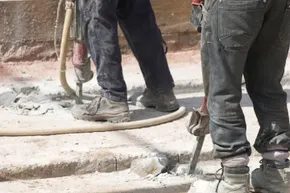
Concrete. Asphalt. Bedrock. These materials are tough by design, built to outlast us all. When a foundation needs to come down or a mountain needs to be moved, a sledgehammer is just a joke. You’re not going to break through that with brute force alone. That is where the jackhammer earns its keep.
These T-shaped beasts are iconic for a reason. They are loud. They are heavy. They are terrifying. But they also combine the impact of a hammer with the precision of a chisel in one mechanized package. Without them, we would still be hacking away at highways with manual tools. Chiropractors would be the busiest people on earth.
“Brawn just wasn’t enough for these exhausting jobs. What these laborers really needed was a more powerful way to break through rock.”
Jackhammers (or pneumatic drills, as some call them) don’t just work faster. They work at all. A sledgehammer is achingly slow. A jackhammer turns a week of labor into a day of noise. But don’t let the simplicity fool you. These tools can weigh nearly 100 pounds. If you drop one, it’s not just a broken tool. It’s a broken foot. Safe operation requires muscle and respect for the weight.
So, how did we get here? The story starts long before the modern demolition site.
The First Real Rock Star
Look back to the mid-1800s. The Industrial Revolution was reshaping everything. Machines were making life easier for factory workers. But miners? Quarriers? They were still using pickaxes and shovels. It was miserable work. Dark tunnels. Damp rock. Explosive gas risks.
Steam engines were the alternative. They were powerful. They were also a fire hazard in a mine shaft. One spark and you’re gone. The industry needed something safer. Something that didn’t rely on combustion.
Enter Charles Brady King.
Most people think of Henry Ford when they think of cars. King actually built the first motorized carriage in Detroit back in 1896. He drove it at a blistering 7 miles per hour. But King didn’t just build cars. He built over 60 different machines in his lifetime.
One of them changed construction forever.
King invented the first pneumatic jackhammer. He used compressed air. No fire. No spark. Just pure, mechanical force. It was a godsend for miners who needed to break rock without blowing themselves up.
Air-Powered Destruction
The pneumatic jackhammer didn’t just solve a safety problem. It solved a speed problem. Compressed air could deliver rapid, high-impact blows directly to a chisel bit. Laborers could finally break through stone without exhausting their backs.
This technology laid the groundwork for everything that follows. Modern electric and gas-powered hammers are just later chapters in this story. But the core idea remains the same.
We need a tool that hits hard. We need a tool that doesn’t give up. And we need one that lets us do it without losing our spines. The jackhammer delivers.
But it’s not just about air. The evolution continued. And the types of jackhammers available today are far more varied than the original air-powered models.
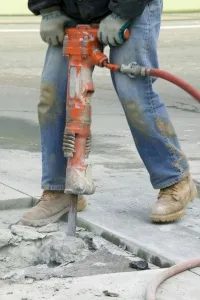
Types of Jackhammers and How They Work
Jackhammers look like they just smash things. Simple. Primal. But inside, it is a mess of complex mechanics. The exact build changes by model. The function stays mostly the same.
You have three main choices. Electric ones. Lighter. Good for small jobs or handymen who don’t want to haul heavy gear. Gas versions. Heavy duty. You use them where there is no power outlet and no air line.
Then there are pneumatic jackhammers. These were the standard for decades. Why? Mining. Underground miners needed to avoid sparks. Combustion engines create sparks. Sparks ignite gas. Compressed air does not. Plus, that air doesn’t lose pressure through long hoses. You can keep the compressor far away. The tool stays powerful.
A pneumatic tool runs on high-pressure air. A diesel engine usually drives the compressor. The air travels through a hose. Then it hits your jackhammer.
The body is a vertical cylinder. It acts as a pressure chamber. Air enters. It hits a trigger valve. This valve opens and closes fast. When it opens, pressurized air fills the piston chamber. Pressure builds. The piston moves down. It hits the bit. The bit hits the rock. Rock fractures.
Then the valve closes. It redirects air below the piston. Air pressure plus a spring pushes the bit back up. The cycle repeats. There is an exhaust valve. It releases pressure during the up-and-down motion.
Hydraulic jackhammers work similarly. But they use fluid, not air. These are big. Heavy. Powerful. They mount to construction rigs. You cannot hold them in your hands. They handle jobs too big for manual labor.
How Percussive Power Breaks Rock
Jackhammers are percussive drills. They pound surfaces into smaller pieces. Gravity helps. The mass of the tool helps. It keeps the machine pressed against the target.
The bit hits 1,000 to 4,500 times per minute. It stresses the surface immediately. Irregular fragments form. The bit turns some of that into powder. Granules. They pool around the tip.
This powder absorbs energy. But it also transfers energy to the surrounding rock. Cracks grow. They stabilize as the bit reaches its maximum depth.
When the bit retracts, it pulls rock chips with it. A small crater forms. Some models have a valve. It blasts air or water. It flushes the debris out.
The operator moves back a few inches. Triggers the hammer again. The process restarts. Small cracks become large ones. Deep fractures join. Large pieces break off. Workers remove them with other tools.
Clearing the crater is mandatory. If you don’t, you just shatter chunks into smaller debris. That debris gets in the way. It slows you down.
Choose the right bit. Basic breaking needs a point bit. Just a sharp metal shard. For cleaner edges, use a flat bit. Narrow or wide. Wide bits don’t penetrate fast. They take longer.
Don’t go too deep. It is easy to get the bit stuck. You will be stuck with it. You will sit there trying to loosen it. Unscheduled break.
Sharp bits are non-negotiable. Dull bits make the machine and the operator work harder. Check the bit often. The harder the rock, the more you check. Sharpen it regularly.
Most work is straight down or on an incline. Horizontal hammering is possible. But the weight is immense. You need two people. Or a jackhammer stand. The stand supports the heft. You don’t.
Overhead work requires smaller tools. Or machine assistance. You cannot swing a heavy pneumatic hammer over your head for long.
Safety and Practical Considerations
Picking up a pneumatic hammer feels like holding a live wire. It vibrates. It shakes your arms. It shakes your bones.
Wear hearing protection. The noise is deafening. Wear safety glasses. Debris flies. Wear steel-toed boots. You will drop things. Or the tool will drop on your foot.
Check the air hose. Look for cracks. A burst hose is dangerous. It whips around. It hits hard.
Make sure the bit is locked in tight. A loose bit can shoot out. It becomes a projectile. You do not want that.
Keep your body out of the line of fire. If the bit jams and releases, the tool jerks backward. Or sideways.
Don’t force it. Let the weight do the work. If you push down too hard, you stall the tool. You burn out the valve. You waste time.
The vibration can cause hand-arm syndrome. Take breaks. Keep your hands warm. Cold hands lose dexterity. You drop things. You get hurt.
Water helps. It suppresses dust. It cools the bit. But it makes the site slippery. Watch your footing. Mud is a hazard.
The rock does not care about your schedule. It breaks when it wants to. Sometimes it is soft sandstone. Sometimes it is granite. You fight the stone. You don’t win. You just manage the breakage.
You will miss. The bit will slip. You will chip the concrete around the area you want to break. That is normal. Clean up the mess. Start again.
There is no magic. Just repetition. Impact. Release. Repeat. Until the hole is deep enough. Or the wall is down. Then you carry the debris away.
And you go do it again.
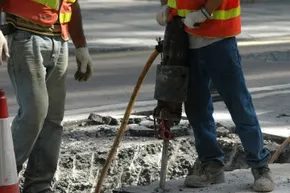
The Human Cost of Heavy Demolition
You think you’re just holding a tool. You’re not. You’re wrestling a living, breathing beast that wants to throw you off a roof.
Jackhammers are heavy. They are powerful. And they treat the human skeletal system like kindling. Even the toughest crew members see their bodies degrade under the weight. That’s why smart sites rotate workers. You don’t let one guy hammer concrete for eight hours straight. His arms will turn to jelly. His focus will slip. And when focus slips, accidents happen.
But the noise? That’s the part that sticks with you.
We all know jackhammers are loud. We hate them for it. Modern models come with silencer boots to dampen the racket. It helps. But it doesn’t change the physics. You are still standing next to a tool that hits 130 decibels. That is louder than a jet engine at takeoff. If you are on the job site, you need hearing protection. Not because some safety manual says so. But because once your hearing goes, it doesn’t come back.
Vibration Damage: What Actually Happens to Your Body
Let’s talk about the vibration. You can buy dampening components. You can wear anti-vibration gloves. But the machine still transfers energy into your bones.
The “relentless violence” of the hammer breaks up concrete. But that force travels up the handle, into your arms, and settles in your nerves. Too much exposure leads to a list of issues that feel like a bad flu but last for years.
- Headaches that won’t quit.
- Stomach issues.
- Insomnia.
- Muscular and skeletal pain.
It’s not just fatigue. It’s damage.
Raynaud’s Phenomenon and Power Tools
Medical researchers have linked power-tool vibration to Raynaud’s phenomenon. If you don’t know what that is, here is the simple version. It affects your blood vessels in the extremities.
After too much jackhammer use, your hands might suffer from poor circulation. Your fingers could turn white. They might go numb. This isn’t a temporary inconvenience. It is a chronic condition triggered by the very work you are doing. You are literally vibrating your blood supply out of compliance.
Protect Yourself
If you are going to do this work, you have to manage the risk. There is no way to make a jackhammer light. There is no way to make it silent. But you can limit your exposure.
Rotate your team. If you are the only one working, take breaks. Step away from the tool. Let your hands recover.
Wear the right gear. Not just any earplugs. High-fidelity ones that let you hear conversation but block the 130dB spike. Anti-vibration gloves if your budget allows. But remember, gloves don’t stop the vibration from traveling up your arms. They only help with grip.
Listen to your body. If your hands go white, stop. If your head starts pounding, step back. You can always buy another jackhammer. You can’t buy a new set of nerves.
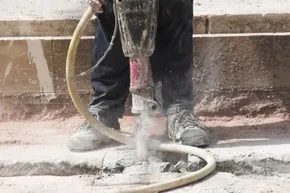
Managing Silica Dust and Debris
When you swing a jackhammer, you aren’t just breaking concrete. You are creating a cloud of fine particulate matter. This isn’t just annoying dust. It is a health hazard. Breaking up pavement releases crystalline silica. Inhaling this dust can lead to silicosis and lung cancer. You need to stop it at the source.
Attach a water spray system to your tool. A hose that delivers several ounces of water per minute is ideal. The mist keeps the surface wet. This suppresses the dust before it enters your lungs. It creates a safer breathing environment. Do not skip this step.
Protecting Your Body and Lifting Weight
Flying debris is a real risk. Shrapnel doesn’t ask for permission before it hits you. Wear long, tough pants and long-sleeved shirts. Cover your skin. Steel-toed boots are also non-negotiable. Your toes will thank you later.
Jackhammers are heavy. They fight back. If you are going to use one for more than a quick fix, look for optional lift-assist technology. This feature pushes the tool upwards out of the ground. It counteracts the weight. Moving the tool around the work area becomes much easier on your back and shoulders.
What Lies Beneath the Surface
Jackhammers work fast. They are powerful. But they are not the right tool for every job. Before you start pounding, you need to know what is under the slab. Buried gas lines lurk beneath the surface. So do electrical cables.
A stray blow can puncture a gas line. Or sever an electrical wire. The result is not just a broken tool. It is an emergency room visit. It is an explosion. It is a shock. Check your local utility maps. Scan the area. Do not assume the ground is empty. The power of the machine is its greatest asset and its greatest danger.
Why We Still Use Them
It is easy to list the dangers. They are obvious. Serious destruction is possible. But that destruction is the point. Without this pounding power, we would be stuck with pickaxes. Or shovels. Or sledgehammers.
Think about that. Imagine breaking up an old highway by hand. You would be there for weeks. Your body would fail before the concrete did. No matter how strong you are, you do not want to do this manually. The machine does the work that human muscle simply cannot sustain.