


We take concrete for granted. You see it in driveways, sidewalks, and parking lots. It just sits there, gray and heavy. But there is a lot more to it than a truck dumping a pile and waiting for it to harden.
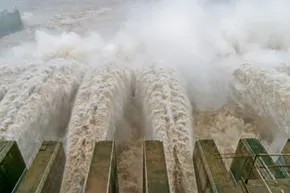
There is a specific “recipe” that has dominated construction for the last fifty years. It is in your kitchen countertops. It is in China’s Three Gorges Dam. It is called fluid concrete.
It sounds counterintuitive. How can something be fluid and strong at the same time?
The Recipe for Strength
All concrete starts with three things: water, cement, and aggregate. The aggregate is usually sand or gravel. The magic happens through a chemical reaction. When water touches cement, it hardens. This is called hydration.
Ideally, you want the least amount of water possible. Why? Because excess water weakens the final product. If you add too much water to make the mix easier to pour, you create pores. Those pores are weak points.
Engineers measure this thickness using a term called slump. Low slump means thick. It is stiff. It does not flow. This low-slump mix creates the strongest concrete. But it is hard to work with. It does not ooze into tight corners. It is difficult to pour into complex forms.
The Chemical Fix
You need the concrete to flow, but you cannot add water. So you use admixtures.
These are chemical additives. They change the behavior of the mix without changing its weight. One specific type is the superplasticizer.
This is the secret ingredient.
A superplasticizer allows the concrete to have a high slump. It becomes thin and liquid. Yet, it does not sacrifice strength. The result is a material that is runny when wet and rock-hard when dry.
A Modern Invention
Concrete itself is old. We have been using versions of it for 7,000 years. Modern Portland cement concrete is about 200 years old. But fluid concrete is new.
Ancient builders tried thinning their mixtures with organic stuff. Milk. Blood. Lard. It didn’t work well. The mixtures remained too thick or weak.
The breakthrough came in the late 1950s. Engineers in Germany and Japan developed the first superplasticizers. The substance hit the market in 1964. It reached the United States in the mid-1970s.
By 1984, the world had produced between 90 and 100 million cubic yards of it. That is 1.5 to 2.3 million cubic meters. Today, it is everywhere.
Contractors love it. It pumps easily. It fills narrow spaces. You don’t need to vibrate it to remove air bubbles. It stays strong.
But how does it actually work? What happens at the microscopic level?
It sounds counterintuitive. Fluid concrete looks wetter, thinner, almost like soup compared to standard mix. Yet the water content is identical. How is that possible?
Electromagnetism.
You likely learned this in high school science but forgot it until now. It’s the secret sauce. Specifically, superplasticizers.
These chemical additives are what separate fluid concrete from the gritty, heavy sludge you’re used to. They fall into a few chemical families: sulfonated melamine-formaldehyde condensates, sulfonated naphthalene-formaldehyde condensates, modified lignosulfonates, or sulfonic-acid esters. The names are long. The mechanism is simple.
When you first mix concrete, water makes cement particles cling together. They clump. The batch thickens. Superplasticizer molecules step in. These long chains attach to the cement particles and slap a highly negative electrical charge on them.
Now the particles repel each other. Negative repels negative. Like two magnets pushed together at the wrong poles. They push apart. The concrete stays fluid.
But this trick doesn’t last forever.
As the concrete sits, hydration begins. Water reacts with the cement. Crystals of calcium hydroxide and calcium silicate hydrate start forming on the surface of the cement grains. Imagine a spiky ball, similar to a sweetgum fruit. These crystals grow. They engulf the superplasticizer molecules.
Once the additive is trapped, it stops working. The negative charge fades. The particles stop repelling. They attract again. The concrete thickens.
This usually happens within 30 to 45 minutes. You can add more superplasticizer to thin it out again. But as more crystals grow and begin to interlock, you need higher and higher doses just to keep the particles apart. It’s a losing battle against physics.
Pumping Fluid Concrete Through Tight Spaces
Unless you’ve been living under a rock, you’ve seen this stuff. Or walked past it. Engineers and contractors use fluid concrete because its thin consistency solves logistical headaches.
Pumping is the biggest advantage. Standard concrete is thick. It fights back. Fluid concrete flows.
Builders pour the mixture into the hopper of a specialized pump mounted on a truck or trailer. From there, it moves through pipes. Rubber or steel. These pipes run along the ground for horizontal moves or attach to mechanical arms—like cherry pickers—for vertical lifts.
Because the mix is so thin, contractors can pump it vast distances or up great heights. They don’t need to crank up the pressure to keep it flowing. Think about drinking a soda through a straw versus a milkshake. The thinner liquid takes almost no effort to pull.
It also fills forms better.
Forms are the wooden or steel molds that hold concrete in shape while it dries. You’ve seen the curbs on sidewalks. The narrow forms for walls are where fluid concrete shines. So are forms packed with rebar (steel mesh or rods) or embedded with pipes and bolts.
The thin mix seeps into tight spaces. It hugs the rebar. It flows around obstacles that would trap air pockets in a standard pour.
No Compaction Required
There’s a labor saving here too. Pouring a level foundation usually requires a lot of manual work. Fluid concrete is thin enough to level itself. It’s like water in a still pool. It finds its own flat surface.
But the real time saver is skipping compaction.
Standard concrete traps air. Bubbles. Weak spots. You have to remove them using a vibrating tool. A small gas or electric motor on a hose that shakes the concrete to force air out.
Fluid concrete? You don’t need to vibrate it. The mixture is too thin for air to get trapped in the first place. You pour it. It settles. You’re done.
The Catch: Sealing and Cost
It’s not all magic. There are downsides.
Because it’s so runny, the forms must be perfectly sealed. Any gap, any crack, and your fluid concrete will leak out. Messy. Wasteful.
There’s also the issue of segregation.
Since the mix is so fluid, the heavy stuff—gravel, crushed stone aggregate—can sink to the bottom. The lighter cement paste stays on top. This weakens the hardened product. It’s not uniform anymore. You get a slab that’s strong on top and sandy on the bottom.
Then there’s the price tag.
Superplasticizers are expensive. You’re looking at an extra $8 to $14 or more per cubic yard. One cubic yard is about 0.76 cubic meters. On a small shed foundation, that’s a few dollars. On a whole house? It adds up fast.
Is it worth it? Depends on the job. Depends on how tight your access is. Depends on how much you hate vibrating concrete.
But the chemistry? That’s solid.
Most people associate concrete with parking lots or industrial warehouses. But there is a specific type moving into residential spaces, and it is changing how homeowners approach interior design. Fluid concrete is the answer for those seeking a smooth, modern look without the pitting common in traditional methods.
You might think this material is just for pouring massive slabs. It works well for patios, sure. But the cost of the superplasticizers needed to make concrete flowable makes large-scale flooring prohibitively expensive for most homeowners. The real sweet spot? Kitchen countertops.
The Texture Difference: Fluid vs. Stiff
To understand why fluid concrete wins for countertops, you have to look at the alternative: stiff concrete.
Stiff concrete is thick. Think clay. The aggregate is usually just sand. Because it is so viscous, it is easy to pack into forms. But there is a catch. Air bubbles get trapped against the mold walls and cannot escape the thick mixture. The result is a surface covered in tiny craters. Some people love this texture; it looks like natural stone.
But if you want a surface that feels like glass, you need fluid concrete.
The Chemistry of Smoothness
Fluid concrete uses a coarser aggregate—gravel or crushed stone. To make that heavy stone mix flow like water, manufacturers add superplasticizers.
“The superplasticizers mean the countertop will have a smooth finish and it’ll be strong and not as susceptible to shrinking and cracking.”
This chemistry does two things. First, it eliminates air pockets, giving you that sleek, uniform look. Second, it increases durability. The mix is less prone to the micro-cracks that plague standard concrete as it cures.
The Formwork Challenge
Here is where DIYers often get stuck. The fluidity is a double-edged sword.
Because the mix is so thin, it cannot hold itself up. If you use the same forms you would for stiff concrete, the fluid mix will leak out or slump. You need watertight forms. Seams must be perfect. Caulk every joint. If you want an integrated sink, the complexity jumps. With stiff concrete, you can just press it around a form. With fluid concrete, you need a complex support structure to hold the weight on all sides until it sets.
Installation and Customization
You have two paths to get these countertops installed:
- Fabricate in a workshop: Have a professional pour and cure them off-site, then install.
- Pour in place: Do it yourself in your kitchen.
Regardless of the method, reinforcement is non-negotiable. You must embed rebar or wire mesh to prevent structural failure.
And no, you do not have to settle for grey. You can add pigments during the mixing process. This allows for custom colors that match your specific aesthetic, turning a utilitarian material into a statement piece.
A Historical Note
Concrete isn’t new. The oldest man-made concrete ever discovered was found in the floor of a primitive shelter in present-day Yugoslavia, dating back to approximately 5600 B.C. Humans have been pouring stone for millennia. Now, they are just doing it with better chemistry and smoother finishes.
The trend isn’t slowing down. As long as homeowners want durability paired with a clean, contemporary look, fluid concrete will remain in the mix.


