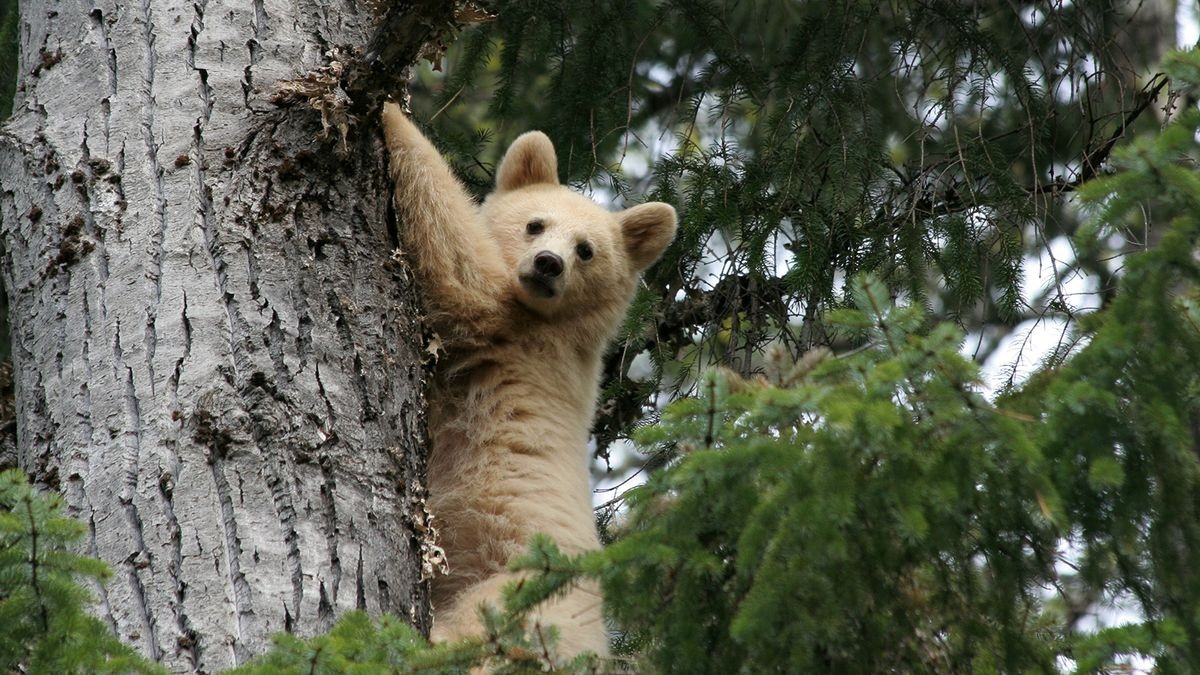
The Great Bear Rainforest of coastal British Columbia is home to one of the most striking and elusive creatures in North America: the spirit bear. These animals, appearing almost mythical against the dark forest and swift rivers, are not a distinct species, but rather a rare color phase of the Kermode bear—a subspecies of the American black bear (Ursus americanus kermodei ). Their creamy white coat, though visually dramatic, is the result of a recessive gene affecting pigmentation, not albinism.
A Genetic Anomaly in a Unique Ecosystem
The spirit bear’s existence is tied to a small, isolated region along Canada’s north and central coast. This area, spanning roughly 6.4 million hectares (15.8 million acres), provides a perfect combination of dense forest, salmon-rich rivers, and coastal islands. The bears themselves carry the MC1R gene, which controls coat color. When a cub inherits this gene from both parents, it emerges with pale fur while still retaining dark eyes and pigmented skin—a key difference from true albino animals.
This genetic variation is relatively rare; only a fraction of black bears in the region are born white. The Kermode bear is named for Francis Kermode, a British Columbia zoologist who first studied these animals decades ago. Their limited habitat—particularly on islands like Princess Royal and Gribbell—makes them exceptionally elusive, accessible primarily by air or sea.
The Salmon Connection: Ecology and Advantage
The Great Bear Rainforest isn’t just a geographical isolation; it’s a thriving ecosystem where marine nutrients from spawning salmon fuel plant life and sustain a complex food web. Spirit bears, like other black bears, are omnivores that feed on berries, roots, insects, and occasional carrion. However, Pacific salmon constitute their most critical food source.
Intriguingly, the white coat may give spirit bears a slight advantage in catching salmon. Research suggests they are up to 35% more successful during daylight hours because the lighter color is less visible to fish underwater. This adaptation highlights the interplay between genetics, behavior, and environmental pressures.
Cultural Significance and Conservation
For millennia, Indigenous communities along the British Columbia coast have coexisted with spirit bears. Groups like the Kitasoo/Xai’xais and Tsimshian consider these animals sacred, traditionally referring to them as moskgm’ol (“white bear”). Stories recount how the Creator Raven turned one in ten black bears white as a reminder of the last Ice Age.
Historically, Indigenous groups protected the bears by avoiding public discussion to deter hunters. Seeing a spirit bear is often believed to bring good fortune or spiritual insight. The animal has become a powerful symbol of the Great Bear Rainforest and the delicate balance between humans and nature in the region.
The spirit bear embodies the unique biodiversity of British Columbia’s coastal rainforests, reminding us that even rare genetic traits can play a vital role in an ecosystem. Their future depends on ongoing conservation efforts and respectful co-existence with the Indigenous communities who have long held them sacred.