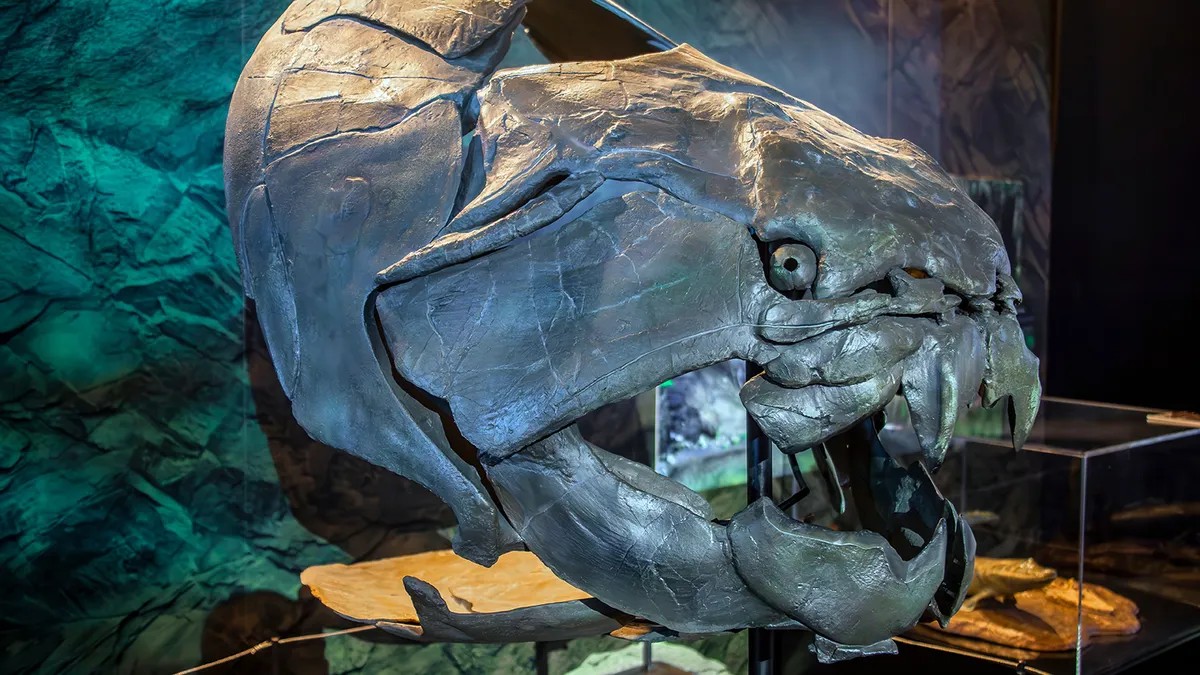
Dunkleosteus was a dominant predator in the Late Devonian seas, roughly 360 million years ago. Reaching lengths of up to 20 feet, this armored fish possessed an imposing skull and bladed jaws that made it one of the most formidable creatures of its time. Its fossils continue to fascinate scientists, offering insights into the evolution of early vertebrates and the structure of prehistoric marine ecosystems.
A Predator Reconstructed From Fragments
The majority of Dunkleosteus fossils consist of armored skull plates and jaws, leaving scientists to reconstruct the creature’s full form through comparisons with other placoderms (an early class of armored fish) and modern aquatic species. The Cleveland Shale near Lake Erie in northeast Ohio has yielded some of the most well-known specimens, studied by researchers from the Cleveland Museum of Natural History for over a century.
Anatomy of an Apex Predator
Unlike modern sharks with teeth, Dunkleosteus’ jaws were lined with sharp bony blades rather than teeth. These bladed jaws acted like self-sharpening shears capable of slicing through prey with incredible force. Biomechanical studies suggest Dunkleosteus possessed an extremely powerful bite and an incredibly fast jaw-opening mechanism, allowing it to crush bone and pierce through even the thickest shells.
Size, Movement, and Lifestyle
Early reconstructions sometimes exaggerated Dunkleosteus’ size, but recent estimates suggest the largest specimens reached around 20 feet long. The animal likely had a stout, deep trunk and a caudal fin adapted for fast, pelagic (open water) swimming, similar to modern sharks. As an apex predator, Dunkleosteus filled an ecological niche comparable to that of modern sharks, preying on fish and other armored species.
The Devonian Extinction and Legacy
The Late Devonian period saw flourishing marine ecosystems, but environmental shifts led to mass extinction events. Dunkleosteus, along with many other armored fish groups, disappeared as these changes disrupted marine life. Today, Dunkleosteus remains one of the most recognizable prehistoric creatures, helping scientists reconstruct the evolution of early vertebrates and the dynamics of ancient ocean predators.
Despite the fragmentary nature of many fossils, Dunkleosteus continues to provide valuable insights into the evolution of powerful ocean predators and the structure of Late Devonian marine ecosystems.
The creature’s unique anatomy and predatory style offer a glimpse into a world dominated by armored giants, a reminder of the diversity and brutality of life millions of years before humans.