Concrete doesn’t simply dry to harden—it undergoes a chemical reaction called hydration. This process requires a constant supply of water, even after the initial pour. Failing to properly cure concrete with water can lead to significant structural weaknesses, premature cracking, and reduced long-term durability. This guide explains why water curing is essential, how it works, and what happens when it’s skipped.
The Science of Hydration: More Than Just Mixing Water In
The misconception that concrete hardens by drying stems from misunderstanding how cement actually works. When cement particles mix with water, they don’t just bind together; they chemically react to form calcium silicate hydrate (C-S-H) and other compounds. This reaction isn’t immediate. It continues for weeks, and even months, after the concrete is poured.
If water evaporates too quickly, hydration stops prematurely. The resulting concrete will be weaker, more brittle, and prone to cracking. This isn’t just a cosmetic issue; it compromises the structural integrity of buildings, roads, and other vital infrastructure.
The Early Stages: Preventing Surface Cracking
The top surface of freshly poured concrete is most vulnerable. Wind, sunlight, and high temperatures accelerate evaporation from the surface before the interior has had a chance to hydrate. This creates plastic shrinkage cracks —tiny fractures that weaken the concrete’s top layer.
Water curing keeps the surface moist, preventing rapid evaporation. This allows the concrete to hydrate uniformly, minimizing cracking during the critical first few hours. Without this, the concrete loses strength before it even has a chance to properly set.
Strength Development: The First 7 Days Matter Most
Concrete gains strength gradually. The first seven days are particularly crucial. If moisture is maintained, hydration continues effectively, and the concrete develops proper strength.
Well-cured concrete exhibits higher compressive strength, improved bonding between paste and aggregate, enhanced abrasion resistance, and superior load-bearing capacity. Poorly cured concrete may feel hard on the surface, but its internal strength will be significantly lower.
Long-Term Durability: Resisting the Elements
Durability isn’t just about immediate strength. It’s about how well concrete withstands long-term exposure to rain, heat, freeze-thaw cycles, and chemical attacks. Proper curing ensures:
- Reduced permeability: Less water and chemicals can penetrate the concrete.
- Minimized microcracks: Fewer pathways for deterioration to begin.
- Improved resistance to chloride penetration: Crucial for structures exposed to saltwater.
- Reduced long-term shrinkage: Minimizing stress and cracking over time.
Temperature Control: Preventing Thermal Stress
Hydration generates heat. In hot weather, rapid temperature increases combined with evaporation can create thermal stress, leading to cracking. Moist curing helps maintain uniform temperature and reduces thermal gradients, preventing surface distress.
Hydration Continues Long After Setting
Concrete sets within hours, becoming rigid enough to hold its shape. But setting isn’t the same as full strength development. Hydration continues for days and months after the initial set.
Without sufficient moisture, the reaction stops prematurely, leaving the microstructure less dense and the long-term strength compromised. Even small reductions in curing time can significantly affect final performance.
The Consequences of Skipping Curing
Poorly cured concrete suffers from:
- Reduced compressive strength
- Surface dusting (weak, crumbling surface)
- Increased shrinkage cracks
- Low abrasion resistance
- Shortened service life
Repairing poorly cured concrete is often expensive and sometimes impossible without complete removal.
How Long Should Concrete Be Cured?
Generally, at least seven days of curing is recommended for ordinary Portland cement. Hot or dry climates require longer curing periods. High-performance structures demand even more extended moisture maintenance.
Effective Curing Methods
Several methods ensure proper hydration:
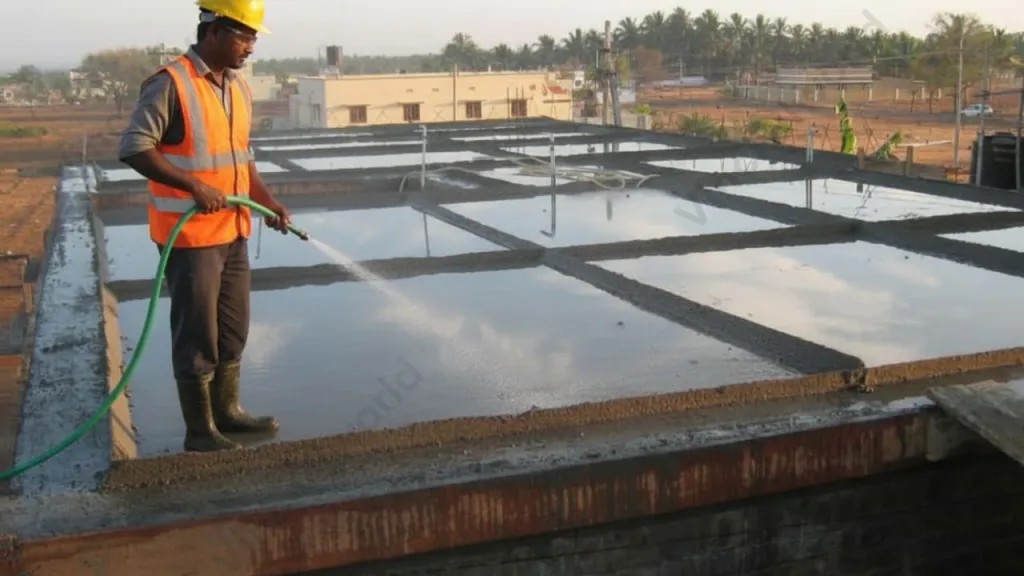
- Ponding: Keeping water pooled on slabs.
- Wet Coverings: Covering surfaces with moist burlap or curing blankets.
- Sprinkling: Regularly spraying water to maintain surface moisture.
- Curing Compounds: Applying chemical membranes to reduce evaporation.
Why Even “Strong” Concrete Needs Curing
In cooler, humid climates, evaporation may be slower, leading some to believe curing isn’t necessary. However, internal moisture loss can still occur. Controlled curing guarantees predictable results rather than relying on chance.
Critical for Structural Integrity
Structural components like slabs, beams, and columns carry loads for decades. Proper curing ensures they achieve their design strength. Inadequate curing compromises structural safety margins, crack control, reinforcement protection, and overall serviceability.
Proper concrete curing isn’t optional; it’s a fundamental step in ensuring long-term structural integrity, safety, and durability.
In conclusion, concrete requires water after pouring because hydration is an ongoing process, not a one-time event. Neglecting water curing leads to weaker, less durable structures. Investing in proper curing methods is essential for any construction project where strength and longevity matter.